The article was published in the special supplement HN – The Future of Industry
Author: Miroslava Kohoutová
Augmented reality in industry is moving from pilot projects into everyday operations. Together with artificial intelligence, it is transforming maintenance and addressing one of the biggest problems: the shortage of senior maintenance technicians. It can also work with large volumes of information and identify the likely cause of a fault within moments. Maintenance itself is simple. All you need to do is put on smart glasses and a remote expert will advise you exactly what to do. They can also draw and highlight individual tasks. Thanks to this, service, maintenance, and solving urgent problems can be handled by almost anyone.
The global virtual reality market for the manufacturing and industrial sector alone is experiencing major growth. According to a study by the analytics and consulting company Fortune Business Insights, it will be worth $8.66 billion this year and will reach nearly $70 billion by 2034.
Czech companies are also beginning to make their mark in the field. The shortage of qualified labor was the impetus for the creation of the Lumnio software. The software captures experts’ know-how, turns it into digital instructions, and enables remote real-time assistance. Pocket Virtuality, the company behind the software, is part of the industrial-technology group CSG.
“Similar technologies reduce the demands on personnel performing maintenance. With a shortage of technicians on the market, the bar is being lowered. And there is no other way – newcomers are not able to effectively take over the know-how of the older generation, and the older generation of maintenance technicians is mostly unable to pass on its know-how through training or by writing complete documentation,” says Bohuslav Paule, director of Pocket Virtuality.
Lumnio focuses primarily on digitizing the know-how of experienced technicians, preparing training materials for the younger generation of technicians, and making information from technical documentation and work procedures accessible. Inside the software is a smart AI assistant. Its inputs consist of company technical documentation, approved work procedures, or historical machine data, and its task is to quickly find the right solution to the situation at hand in response to a user’s query. If a technician is unsure, with the press of a single button they can call in remote support from a senior technician. That person advises them while sitting at home or lying on a lounge chair by the pool.
“Every technician has Lumnio in an app on their phone. With the help of an AI chat, they can easily search for a technical solution to a problem, launch a guided procedure, and if they do not know what to do, they click and call for help. It is like a WhatsApp call with many functions for remote assistance and maximum security,” says Bohuslav Paule about the platform, which combines smart glasses, a mobile app, and AI tools for digitizing maintenance.
Consulting with an expert thousands of kilometers away is nothing unusual. Support takes place in multi-user calls, so several specialists often join at once, creating a small technical panel. External experts can also be invited to help, for example technicians directly from the equipment manufacturer in Germany or China.
AI generates instructions directly from video
According to the Maintainly website, 2.1 million workers will be missing in industry by 2030, and one-third of current technicians are already over 55 today. Manufacturing companies are already mainly dealing with how to ensure quality and accessible maintenance. In production, the shortage of people can be partially addressed through robotization, but that does not apply to maintenance itself. In maintenance, humans will remain irreplaceable for a long time to come. If only because documentation for maintenance tasks themselves rarely exists. It exists only in the heads of experienced maintenance technicians. Young technicians are also a challenge, as they no longer learn from manuals but from videos, short visual instructions, and AI chats. “Experienced maintenance technicians are seniors not only in terms of knowledge but also age. It is a generation of technicians approaching retirement that must pass its experience on to the new generation. Our education system is not producing new technicians who could easily take over the maintenance baton. The younger generation cannot handle reading extensive technical documentation and learning from it how to keep machines running. They learn differently – they ask AI and watch short YouTube and TikTok videos,” explains Bohuslav Paule.
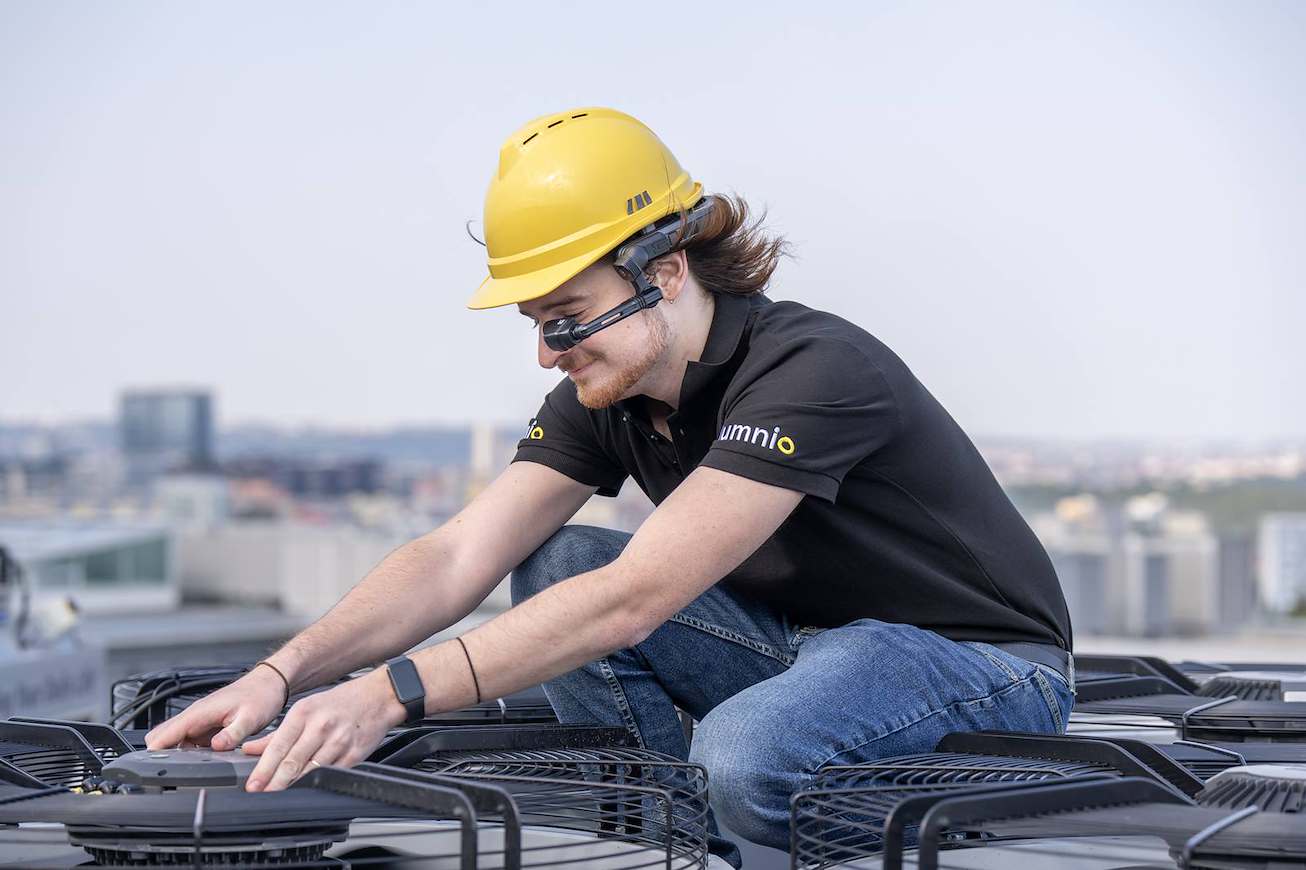
A senior technician passes on knowledge simply by putting on smart glasses and recording their normal work. The software can process the video into a step-by-step work procedure, supplemented with short instructional videos and illustrative images. The resulting instructions are clear, visual, and practical, so young technicians can quickly understand them and work safely according to them.
Smart glasses give senior technicians the opportunity to pass on their know-how from their own perspective. Both hands and individual movements are visible in the shot. At the same time, the glasses’ microphones suppress ambient noise. The technician continuously comments on their work. Artificial intelligence then processes the resulting recording together with the available technical documentation and proposes a complete work procedure. It contains: a clear description of each step, illustrative images, short videos of up to ten seconds, and a list of the necessary tools and materials. The final instruction guide is checked and approved by a senior technician.
“The system itself recognizes the steps, writes in the manual, for example, ‘now loosen these six screws,’ and attaches an enlarged photograph or a ten-second video localized for the specific task,” Bohuslav Paule demonstrates with an example.
In manufacturing, artificial intelligence is increasingly being applied to predicting failures from sensor data, identifying the causes of problems, camera-based quality inspection, optimizing maintenance plans, or analyzing service data. In Lumnio, it is also used to create instruction guides from recorded video, for AI chat over available documentation and work procedures, and for various support functions, such as translating work procedures into different languages, transcribing recordings of technical calls, or translating calls speech to speech.
Lumnio is now used by dozens of customers. These are mainly manufacturing companies and firms that provide service services. The technology is used both in smaller companies and in large international corporations. Customer support can also be provided for ordinary households.
“Imagine a manufacturer of household boilers, where the boiler user has Lumnio on their phone. And access to clear documentation, visual guides for basic maintenance, scheduled mandatory inspections, and one-click connection to the customer center for assistance,” says the head of Pocket Virtuality.
The company is also involved in extensive projects within the CSG group, especially with Tatra Defence and Excalibur Army. The technology is used, for example, in Tadeas and Titus armored vehicles or in the Dita howitzer.
Another advantage of the software solution is that artificial intelligence can process thousands of pages of manuals. Thanks to this, with complex machines or military vehicles, a problem can be solved quickly even in field conditions. The Lumnio solution already represents more than 30,000 programming hours and operates in Europe, the USA, Mexico, South Korea, Japan, and Oman. In addition to Czech and Slovak, technicians also use Polish, Ukrainian, Filipino, and Bulgarian.
Lumnio is used most in engineering and industrial manufacturing. However, it also has great potential in healthcare, for example with emergency services or military medicine. “Today, the limits stem more from the environment in which smart glasses can be used. But the current generation of devices can handle even extremely demanding operations, whether in noisy halls, dusty environments, or outdoor conditions. For example, at České dráhy we can help with the maintenance and servicing of almost 300 types of vehicles,” says Bohuslav Paule.